 how-to
Learning to Drive as an Adult: A Complete 2026 Guide
Table of Contents
- Why Adults Choose to Learn to Drive
- Adult Driving Lessons: What to Expect
- How Long Does It Take to Learn to Drive?
- Getting Your Provisional Licence and Preparing for Tests
- Driving Lessons for Nervous Adults: Building Confidence
- Private Practice with a Learner Driver: Maximising Your Progress
- It's Never Too Late: Strengths of Adult Learners
- Choosing Between Manual and Automatic Transmission
- Frequently Asked Questions
Last Updated: October 21, 2026
Why Adults Choose to Learn to Drive
Learning to drive as an adult opens doors, for work, independence, or a fresh start in a new area. Many put it off for years, then realise they can't wait any longer.
The barriers feel real: you worry you're too old, you'll struggle compared to teenagers who learned at 17, or the cost isn't worth it. But adults often make better learners, motivated, focused, and serious.
Some come after relocating, others need a licence for their careers, and many are simply ready to reclaim their independence.
Adult Driving Lessons: What to Expect
Your first lesson sets the tone. A good instructor understands where you're starting from rather than throwing you into traffic, and explains each stage and why it matters.
Early lessons focus on the basics:
- Getting comfortable in the driver's seat
- Understanding the controls and how they work
- Moving the car smoothly in a quiet area
- Building muscle memory for steering and pedal control
You won't be on a busy road in week one. Progression is gradual, each lesson building on the last until skills feel natural.
What makes adult driving lessons different is the pace. Nervous adults need patience, clear explanations, and room to ask questions without feeling rushed.
Expect feedback, some praise, some correction. Both are valuable; the goal is progress, not perfection.
How Long Does It Take to Learn to Drive?
There is no legal minimum number of driving hours in the UK. The Driver and Vehicle Standards Agency (DVSA) does not require a set number of lessons before the practical test, you simply need to drive safely and legally.
A realistic timeline for learning to drive as an adult is usually between 4 and 12 months. The spread is wide because several factors interact:
- Lesson frequency: One lesson a week keeps skills ticking over but stretches the calendar. Two shorter lessons a week often suit adults better because retention improves.
- Private practice: Supervised practice between lessons is the single biggest accelerator. Learners who practise twice a week in addition to lessons typically progress noticeably faster than those who only drive during lessons.
- Starting point: If you have never sat in the driver's seat, you will need more time than someone who drove abroad, rode a motorcycle, or has sim racing experience. Prior road sense transfers even when the controls do not.
- Test availability: Practical test slots can be booked weeks or months ahead in many areas. Build waiting time into your plan rather than assuming you can test the moment your instructor says you are ready.
- Test readiness: Your instructor's judgement matters more than a calendar. Booking before you are consistently safe wastes the fee and can knock confidence.
A practical weekly pattern for many adults: one 90-minute or two 45-minute lessons, plus one or two 30-45 minute private practice sessions on quiet routes. Over a typical 6-9 month run, that adds up to the exposure the DVSA survey data describes.
Several things genuinely slow adults down: long gaps between lessons, practising only what you find easy, avoiding the manoeuvres that make you anxious, and switching instructors repeatedly. Consistency beats intensity.
If you have a deadline, a new job, a move, a family need, tell your instructor early.
Getting Your Provisional Licence and Preparing for Tests
Applying for Your Provisional Licence
Before you can legally drive on a public road as a learner in the UK, you need a provisional licence, your first official step, and simpler than many adults expect.
Apply online through the DVLA (Driver and Vehicle Licensing Agency) at gov.uk. You will need:
- Proof of identity, usually a valid UK passport, or your biometric residence permit if you are not a British citizen
- Your National Insurance number, if you have one
- Addresses for the last three years
- A debit or credit card for the fee
The provisional licence application fee is £34 online, or £43 by post using a D1 form from a Post Office (Driving licence fees). The licence is valid until your 70th birthday (or three years if you are over 70), so there's no rush to renew it mid-learning.
Once your provisional licence arrives, you can drive as long as:
- You are supervised by someone aged 21 or over who has held a full licence for that category for at least three years
- The car displays L plates (D plates are also permitted in Wales)
- The car is taxed, has a valid MOT, and is insured for learner drivers
- You do not drive on a motorway unless accompanied by an approved driving instructor in a dual-control car
Booking and Preparing for the Theory Test
The theory test is booked separately through the DVSA, usually via gov.uk, at £23 per attempt (Book your theory test). You can book as soon as you have your provisional licence, and many adults sit it early so the road knowledge supports their practical lessons.
The test has two parts, taken in one sitting:
- Multiple-choice questions: 50 questions, and you need 43 correct to pass. Questions are drawn from the official theory test question bank, which is published by the DVSA.
- Hazard perception: 14 video clips containing 15 developing hazards. You score up to 5 points per hazard depending on how early you identify it, and you need 44 out of 75 to pass.
Preparation that works:
- Study the official Highway Code and DVSA theory test materials rather than relying on free quiz apps alone
- Practise hazard perception with the official DVSA practice clips, since the real test uses the same style of footage
- Link theory to practice, when your instructor explains a rule, connect it to the question bank so it sticks
The Practical Driving Test
The practical test is booked through the DVSA and costs £62 on a weekday or £75 for evenings, weekends, and bank holidays (Driving test costs). The test lasts around 40 minutes and includes:
- An eyesight check and two vehicle safety questions (the "show me, tell me" questions)
- One of three reversing manoeuvres: parallel park, bay park, or pull up on the right and reverse
- A section of independent driving, usually following sat-nav directions for around 20 minutes
- Potentially an emergency stop, which happens in around one in three tests
You will pass if you make no serious or dangerous faults and no more than 15 driving faults. Your instructor should run mock tests so the format feels familiar before the real thing.
Driving Lessons for Nervous Adults: Building Confidence
Anxiety about driving is real, traffic, roundabouts, losing control, or a negative experience years ago. Whatever the source, nervousness is treatable, not permanent.
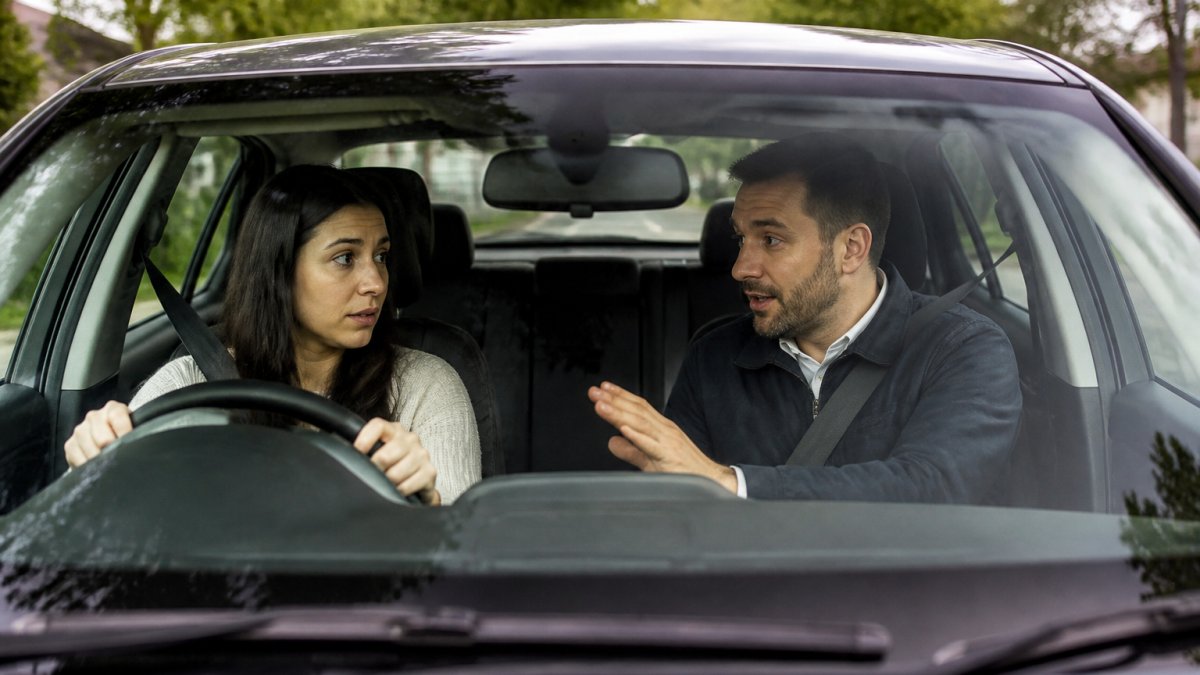
The right instructor makes all the difference: acknowledging your anxiety without dismissing it, starting in low-stress environments, and celebrating small wins until driving feels manageable.
Practical strategies help:
- Take lessons at quieter times if traffic stresses you
- Practice the same route multiple times until it feels familiar
- Use breathing techniques before and during stressful drives
- Break challenging skills into smaller steps
- Celebrate progress, even small improvements
Female learners sometimes prefer a female driving instructor. This is valid. If you're more comfortable learning from a woman, say so.
Nervous adults often become excellent drivers because they're cautious and aware.
Private Practice with a Learner Driver: Maximising Your Progress
Between lessons, you'll practice with a learner driver plate on your car and a qualified supervisor in the passenger seat. This is where real progress happens.
Private practice differs from lessons.
Make practice count:
- Pick quiet routes initially, then gradually increase difficulty
- Practice the same skills your instructor focused on
- Drive for 30-45 minutes at a time (longer sessions become tiring)
- Practice twice a week if possible (weekly is the minimum)
- Ask your supervisor for specific feedback
- Keep notes on what felt difficult, discuss it with your instructor
The combination is powerful: lessons teach the skill, practice embeds it. Without practice you forget between lessons; with consistent practice you build the muscle memory and road awareness that makes you safe.
Many learners underestimate private practice. It's not optional, it's the difference between 12 months and 6 months, and between passing first time and needing multiple tries.
It's Never Too Late: Strengths of Adult Learners
You might worry that learning to drive as an adult puts you at a disadvantage. The opposite is often true.
Adult learners bring strengths younger drivers don't have:
- Motivation: You chose to learn. You're not doing it because you turned 17. This focus is powerful.
- Life experience: You understand consequences. You're less likely to take reckless risks.
- Patience: You know that skills take time. You're not frustrated by a gradual learning curve.
- Discipline: You show up for lessons. You do the work. You don't skip practice.
- Problem-solving: When something doesn't work, you adapt rather than give up.
These aren't minor advantages. They're fundamental to becoming a safe driver.
Adult brains learn differently than teenage brains but just as well: you may process information more slowly at first, but you retain it better, see patterns faster, and connect theory to practice more easily.
The timeline might be slightly longer than a 17-year-old's, but the outcome is often better. Adult learners tend to be thorough and deliberate.
Choosing Between Manual and Automatic Transmission
This decision affects your learning journey and your options after you pass.
Manual cars require clutch control, gear changes, and three pedals, more complex, but full control of the engine.
Manual teaches you more about how a car works, and a manual licence lets you drive any car.
Consider your needs:
- Choose automatic if: You want to reduce cognitive load, you're older or have physical limitations, you'll primarily drive modern cars in urban areas.
- Choose manual if: You want maximum flexibility, you might drive older or hire cars, you want to understand vehicle mechanics more deeply.
At M&A Drive School, we offer both. Your choice depends on your goals and comfort level.
Learning to drive as an adult is entirely achievable. It requires commitment, the right instruction, and consistent practice.
Frequently Asked Questions
How long does it take an adult to learn to drive?
Most adults require 40-80 hours of professional instruction plus supervised practice to reach test-ready standard, though this varies based on prior experience, natural aptitude, and practice frequency. Adults often have stronger motivation and life experience, but consistency matters more than age. Starting with regular weekly lessons and practising 2-3 times per week typically allows you to attempt your practical test within 4-6 months of beginning lessons.
Can I practise driving with a friend or family member as private practice with a learner driver?
Yes. Private practice with a learner driver is legal and highly effective. Your supervisor must be at least 21 years old, hold a full driving licence, and be insured to supervise. Practising between professional lessons reinforces what you've learned, builds muscle memory, and accelerates confidence. Many learners find that combining structured instruction with supportive private practice leads to faster progress and better test readiness than lessons alone.
What should I do if I'm nervous about learning to drive?
Driving lessons for nervous adults work best with an instructor who listens, explains clearly, and progresses at your pace. Start in quiet areas to build foundational skills before tackling busier roads. Use relaxation techniques before lessons, set small achievable goals each session, and celebrate progress. Many nervous learners find that systematic, patient instruction combined with regular practice in a supportive environment can help build competence and independence.
How much does learning to drive cost, and what's included?
Costs depend on lesson frequency, duration, whether you choose manual or automatic instruction, and the number of hours you need before attempting your test. Pricing varies by instructor and location. Contact M&A Drive School directly for current rates and a personalised quote. Many learners benefit from intensive lesson packages or flexible scheduling options, so ask about what suits your budget and timeline.