 How-to
How Reflection Journals Help You Pass Your Driving Test
Last Updated: October 28, 2026
Quick Summary
A reflection journal helps learner drivers review each lesson, noting what went well, what to improve and what to ask their instructor next. Writing this down after every drive turns instructor feedback into a focused practice plan. The research cited here supports journaling as a learning tool, though it does not measure driving-test pass rates directly.
- Write a short entry after each lesson covering what you practised, what went well, and one thing to improve.
- Group instructor corrections into themes such as observation, speed control or positioning, then focus on one theme at a time.
- Set one small, clear goal for the next two or three drives, such as checking the right mirror before every lane change.
- Track when nerves appear, such as at roundabouts or during emergency stops, and note how practice in that situation feels.
- Bring your journal to your first lesson so you can review past entries with your instructor.
Table of Contents
- Why a Reflection Journal Helps Learner Drivers
- What the Research Does and Does Not Show
- Setting Up a Driving Lesson Journal
- Driving Practice Reflection Questions to Use After Each Drive
- Turning Instructor Feedback Into a Learner Driver Practice Plan
- How to Overcome Driving Test Nerves Through Reflection
- Booking Your Next Lesson With M&A Drive School
- Frequently Asked Questions
Why a Reflection Journal Helps Learner Drivers
Learning to drive is a skill, and looking back at what you did can help you reflect. A reflection journal gives you that habit. After each lesson, you write down what happened, what went well, and what you want to work on next. Over time, the notes can help you notice patterns.
M&A Drive School builds reflection journals into its teaching approach. The idea is simple: your instructor guides the lesson, and your journal keeps the learning going between sessions.
Nervous learners can use journaling to write down a worry as a specific task, such as "I hesitate at junction exits" or "I check my mirrors too late on the left."
What the Research Does and Does Not Show
Reflective journaling has been studied in education, although none of the studies mentioned here were run on driving tests specifically.
Research on practical skills describes journals as a way to reflect on hands-on experience and gain perspective by rereading what you have written (Murillo-Llorente and co-authors, 2021). Other studies link reflection-journal writing with lifelong learning skills and with the ability to review your own learning process (D. Alt and co-authors, 2022; M. D. N. Lew and co-authors, 2011). You can read more about these ideas in Using the Reflective Journal to Improve Practical Skills.
Here is what the research does not show. None of these sources measured driving-test pass rates. There is no direct proof that a journal alone makes you pass. A journal is a learning tool, not a guarantee.
Be wary of anyone who promises a pass in exchange for a journal. Treat the journal as a place to organise and revisit your instructor's feedback, not as a replacement for instruction.
Setting Up a Driving Lesson Journal
Keep your journal simple. You can also pair your written reflections with theory training resources to prepare for your driving test. You could use a basic notebook or a notes app on your phone.

Use a consistent layout for every entry:
- Date and lesson focus: for example, "Roundabouts, 14 March"
- What I practised: the skills you worked on
- What went well: one or two things you did confidently
- What to improve: one specific thing for next time
- Question for my instructor: anything you want to ask
You could write your entry soon after the lesson, while the details are fresh. Keep it short. Reading back through past entries before a lesson gives you a chance to review them.
Driving Practice Reflection Questions to Use After Each Drive
The prompts below are tied to driving skills. You can use them after a drive, whether it is a lesson or practice with a supervising driver. Each group concerns an area of driving performance.
Observation and mirrors
- Did I check my mirrors before I changed speed or direction, every time?
- Which mirror do I forget most often, and at what kind of junction?
- Did I look far enough ahead, or was I reacting late to hazards?
Signals and communication
- Did I signal in good time, and did I cancel it afterwards?
- Was there any moment when another road user seemed unsure of my intention?
Speed control
- Did I approach junctions at a speed that let me stop safely if needed?
- Where did I drift above or below the limit without noticing?
Manoeuvres
- Which manoeuvre felt least controlled, and at which step did it break down?
- Did I complete my checks before moving, or during the move?
Hazard response
- What was the closest moment to a problem, and what triggered it?
- Did I spot the hazard early enough to respond smoothly rather than sharply?
Instructor feedback
- What did my instructor correct, and can I explain in my own words why it matters?
- What is one thing I will do differently on my next drive?
Answer each question in a sentence or two. A strong answer names the situation, the behaviour and the fix. For example, instead of "mirrors were bad", write "On the A956 roundabout I checked the right mirror after signalling, not before. Next time I will check before I signal."
If you cannot answer one of the prompts, that is useful information too. Write it down and raise it at your next lesson.
Turning Instructor Feedback Into a Learner Driver Practice Plan
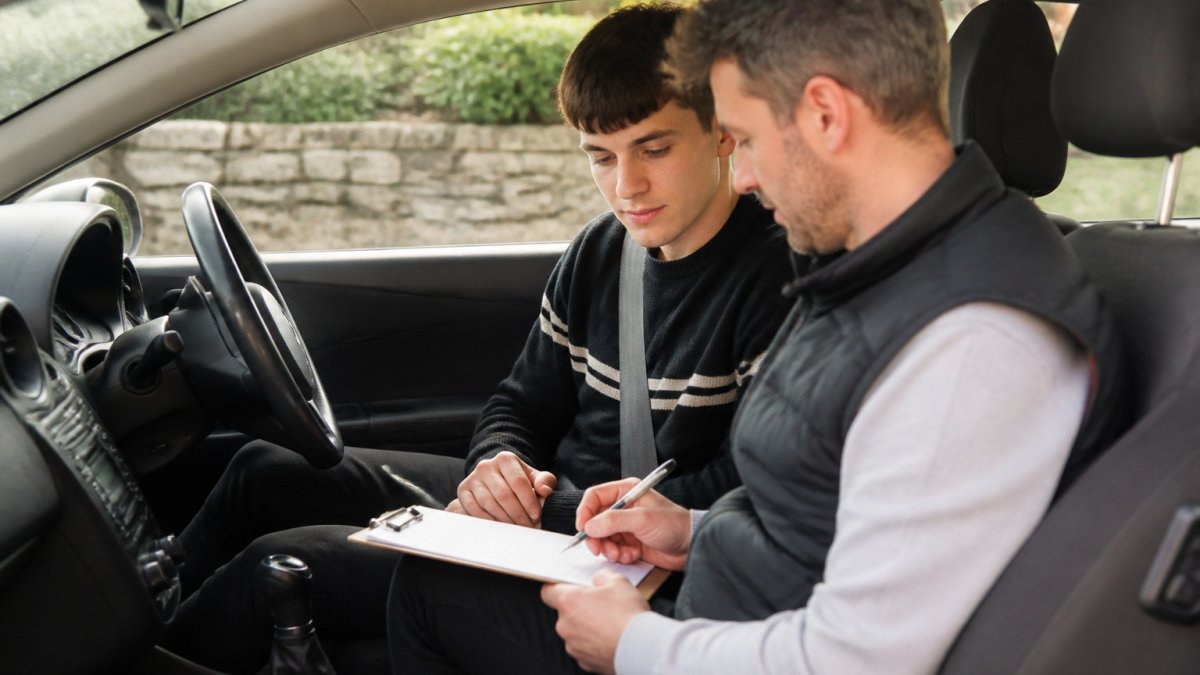
You can use instructor feedback as a basis for action. Hearing a correction and applying it are separate steps.
Try this simple process:
- Write down each correction in your journal exactly as your instructor said it.
- Group the corrections into themes, such as observation, speed control, or positioning.
- Pick one theme to focus on for the next two or three drives.
- Set a small, clear goal, for example "Check the right mirror before every lane change this week."
- Review at the next lesson and decide whether to keep the same focus or move on.
This can help organise feedback into a practice plan.
You could set a reminder to read your journal before each lesson.
The steps below show how to move from an instructor's correction to a focused practice plan.
| Step | What to do | Time or frequency |
|---|---|---|
| Write down each correction | Record it in your journal exactly as your instructor said it | After each lesson |
| Group the corrections | Sort them into themes such as observation, speed control or positioning | After each lesson |
| Pick one theme | Choose one focus area for the next drives | Before your next drive |
| Set a small, clear goal | Example: check the right mirror before every lane change | This week |
| Review at the next lesson | Decide whether to keep the same focus or move on | At your next lesson |
How to Overcome Driving Test Nerves Through Reflection
You can use reflection to note how you feel before a test. The aim is not to stop feeling nervous. It is to consider what to do when the feeling appears.
Use your journal to track when nerves show up. Do they come at roundabouts, during emergency stops, or when someone is watching? You can note the pattern and write down how practice in that situation feels.
You can also note your wins. A short entry might be "Handled the busy junction calmly today".
You can talk with your instructor about how you feel. For more practical tips on passing the test first time, see first-time pass tips.
Booking Your Next Lesson With M&A Drive School
M&A Drive School offers manual and automatic lessons, practical and theory test preparation, and a flexible booking system. Our instructors use a systematic approach that includes reflection journals. You can see what some of our learners have said about their lessons and find out more about our instructors on our website.
For lesson options, visit our booking page or get in touch with the team directly. You can find out how to book an intensive driving course step by step. Bring your journal to your first lesson.
Frequently Asked Questions
How can a reflection journal help with driving test preparation?
A reflection journal gives you something from each lesson to review. You can write down what went well, what felt difficult and what your instructor asked you to work on. You can reread entries before your next lesson. The research cited describes journals as a tool for reflecting on practical experience, although the sources reviewed do not measure driving test pass rates directly.
What should I write in a driving lesson journal?
Keep each entry short and specific. Record the date, the route or manoeuvre practised, one thing you handled well, one thing that needs work and a question for your instructor. You can note how you felt before and after the drive. Avoid vague entries such as 'went okay'. An example entry is 'hesitated for two seconds at the junction on the left, checked mirrors late'.
How often should I reflect on my driving practice?
You can reflect after a drive, even briefly. You can review your last few entries before a lesson or practice session and read through the journal periodically to look for recurring topics.
Can journalling help reduce driving test nerves?
You can write about anxious moments and note what happened and what you did next. This is a way to use reflection, but it is a support tool, not a replacement for practice. If nerves are severe, talk to your instructor about how to structure lessons around them.